01 · MDPath analysis

Allosteric communication, quantified.

MDPath quantifies allosteric communication, state transitions, and receptor microstate populations — connecting molecular dynamics directly to functional phenotype.

Score every pathway against what works. Candidate paths are benchmarked against reference ensembles with known functional outcomes: the right paths confirmed, the wrong ones flagged. No more guessing which motions matter.

Map the paths. Find the pockets. Design with mechanism. Allosteric pockets emerge directly from MDPath's communication analysis — each one linked to the pathway it controls and the function it drives. Not just druggable sites, but druggable sites you can explain.
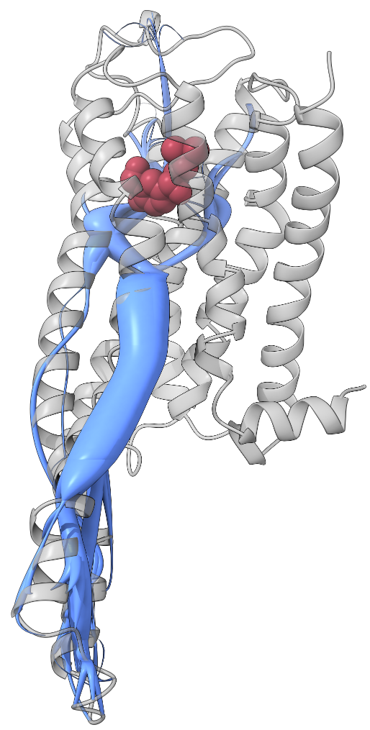
MDPath analysis of a GPCR: ligand bound in the orthosteric pocket, allosteric communication path traced through the helical bundle to the cytoplasmic side.
02 · Enhanced sampling

GPU-accelerated, next-generation enhanced sampling.

GPU-resident from the first kernel to the last. No PCIe round-trip, no CPU sync, no compute spent shuttling data — the whole GPU works on your scientific question.

Built on the same architecture that powers GLUED (opens in new tab), our open-source enhanced-sampling engine for OpenMM. Methods include WT-MetaD, OPES, OPES-Expanded, walls, restraints, and multi-walker variants — across CUDA, OpenCL, and reference backends.

03 · Unbiased MD simulations

Production-grade molecular dynamics, end to end. (in development)

From system setup to analysis — so your team gets mechanistic insight, not raw trajectories.

Standard metrics, done right. RMSD, RMSF, distances, contacts, hydrogen bonds, and beyond — every observable you need to characterize stability, flexibility, and conformational behavior.

Ligands, tracked in motion. Dynamic pharmacophore analysis and binding-mode classification reveal how your ligand actually behaves in the pocket — which interactions persist, which break, and which conformations matter for SAR.

See it on a real target.

Browse peer-reviewed case studies showing MDPath applied to GPCRs, kinases, and ligand-specific allosteric effects.

Case Studies